
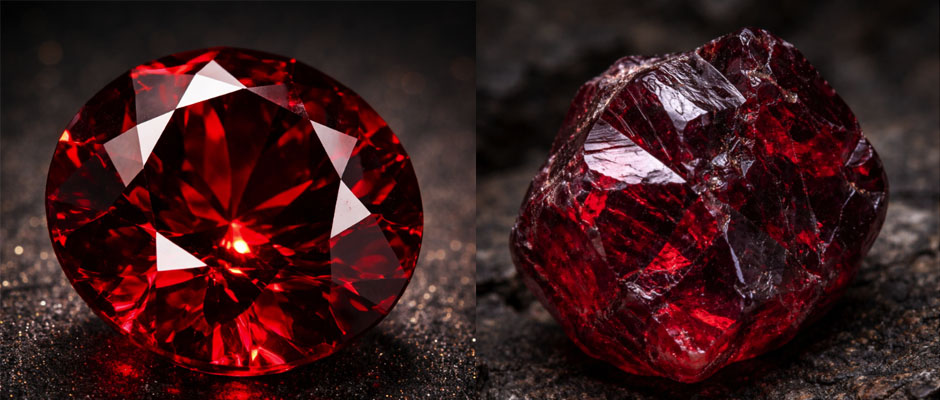
Garnet is not rare; it can be found in Europe, including in the Czech Republic, Austria, Sweden, Finland, Poland, and Russia. It is one of the first gemstones for collectors, amateur cutters, and prospectors in rivers and quarries (an exciting activity also called river washing or panning). It is an affordable gemstone, both raw and cut. A colorful panoply, some red stones can rival rubies and some green emeralds. Garnet was very popular from the Middle Ages to the end of the 19th century.of begin 20you arecentury, in Art Deco, Belle Epoque, Victorian, Edwardian jewelry.
Each mineral is characterized by its crystal structure (atomic structure) and its chemical composition. The constituent elements are ions, which are positively or negatively charged atoms that occupy various positions within the crystal structure. During crystallization, the ions arrange themselves in a specific order, thus forming the garnet structure, which has cubic symmetry. Rhombic dodecahedra and trapezohedra are nesosilicates.
Although all garnets possess the same crystal structure, they can still be composed of different, albeit similar, atoms. This explains the great diversity among garnets. Natural garnets have been studied to discover the various constituent elements and their quantitative ratios. The results are expressed and summarized in the form of a chemical formula.
The latter indicates the number of chemical elements present (as individual ions) in the crystal, as well as their relative abundances. These are expressed in the small number (index) that appears at the bottom right of the element in question (symbol). The following compounds, located at the end of a series and therefore chemically important, are important in describing the gemstones of the garnet group.
-
Pyroop: Red to brownish
Hardness 7/7.5 – Specific gravity 3.65/3.80 – Refractive index 1.730/1.760
Chemical: Mg3 Al2 (Not4) 3 of magnesium - aluminiumsilikaat -
In Almandi: Red – violet
Hardness 7.5 – Specific gravity 3.95/4.20 – Refractive index 1.78/1.81
Chemical: Fe3 Al2 (Not4) 3 or iron – aluminum silicate (is magnetically testable) -
Spessartia: Orange to reddish brown
Hardness 7/7.5 – Specific gravity 4.12/4.20 – Refractive index 1.795/1.815
Chemical: Mn3 Al2 (Not4) 3 or manganese – aluminum silicate -
Grossular: Green, yellow to brown
Hardness 7/7.5 – Specific gravity 3.60/3.68 – Refractive index 1.738/1.745
Chemical: Ca3 Al2 (Not4) 3 of calcium – aluminiumsilikaat -
Deny: Green to emerald green
Hardness 6.5/7 – Specific gravity 3.82/3.85 – Refractive index 1.888/1.889
Chemical: Ca3 Fe2 (Not4) 3 or calcium – iron silicate -
Uvaroviet: Green to dark green
Hardness 7.5 – Specific gravity 3.77 – Refractive index 1.870
Chemical: Ca3 Cr2 (Not4) 3 or calcium – chrome garnet
These various chemically pure types exist only in the form of synthetic crystals; the natural crystals are impure and are usually transitional forms between the various types mentioned.
Garnets can be divided into two distinct chemical groups, designated by the first letter of each mineral. For example, the Pyralspite group consists of the aluminum-rich garnets pyrope, almandine, and spessartine. The Ugrandite group consists of the calcium-rich garnets uvarovite, grossular, and andradite. Grossular is a garnet rich in Ca and Al, and thus possesses the properties of both groups.
Besides the aforementioned variety, other types of garnets are easy to imagine; after all, there are other elements that can be integrated into the general chemical formula for garnets. For example, there is synthetic Kuorringite (Mg3 Cr2And3 012) and Goldmanite (Ca3In2And3 012) . In addition, garnets without silicate were synthetically prepared and used as a substitute for diamond. For example, YAG (Y3 Al2 Al3 012) a GGG (Gd3Here2Here3 012) from the “Golden sixties”.
A crystal visible to the naked eye contains the mineralogical formula billions of times. The smallest possible garnet consists of a single formula unit; this is called a molecule. A crystal of any size therefore consists of billions of garnet molecules. Because each type of garnet has its own chemical composition, these characteristics have physical values.
The garnets already described all have an ideal and theoretical chemical composition, which is rarely encountered in nature. Natural garnets are generally “mixtures.” During crystallization of garnets in nature, various divalent and trivalent ions are available. For example, a natural garnet will simultaneously contain Mg2+ in Faith2+ contain. Pyrope and almandine molecules are formed in parallel.
A “mixed crystal” is formed, the chemical composition of which lies between the two corresponding pure poles. Pyrope and almandine are (in any ratio) intermiscible. They form a series of mixed crystals.
A mixed crystal, for example, consists of two components: pyrope and almandine molecules. Most natural garnets are mixed crystals, consisting of two or more pure elements (in variable proportions). Mixed crystals are usually homogeneous from an optical standpoint; they can be compared to solid solutions. In a crystal, 40% of the almandine molecules are “dissolved” in 60% pyrope.
Certain garnets allow for limited mixing with other garnet types. Garnets from the pyralspite group have been found to possess significant miscibility. Similarly, garnets from the ugrandite group are intermiscible. However, mixing of garnets from both groups is very rare. The spaces in between where non-existent mixing ratios occur in nature are called “miscibility gaps”.
Genuine garnet gemstones will represent various types of garnet. The principle of miscibility between two chemical compounds that share the same crystal structure results in a wide variety of mixed crystals. Their color, refractive index, and density are also influenced by the properties of the pure elements. The type of garnet formed during crystallization depends on the available material, local geological factors, and physicochemical factors.
The correct naming of the individual garnets is often preceded by non-destructive chemical analyses, the results of which provide quantitative data about the garnets of the pure elements.
Pyrope-almandine garnets: The most common garnets are the red stones of the mixed pyrope-almandine series. If the colorless pyrope contains 10-40% almandine, it develops a pleasant red color. Higher almandine concentrations result in darker garnets; pure almandine is a very dark red. Rhodolite is a variety of pyrope-almandine (light violet-red) with 10-25% almandine.
A few percent of almandine molecules are sufficient to produce color effects. Therefore, the absorption spectra of light rhodolites contain almandine moieties at 575, 527, and 507 nm. Pyrope, which is colorless in its pure state, can be colored by garnets other than almandine. The idiochromatic varieties spessartine (yellow) and knorringite (red) are miscible with pyrope. The blood red chromopyrope contains a small amount of kuorringite molecules (Mg3 Cr2And3 THE12).
Certain garnets, essentially composed of pyrope-almandine mixtures, still contain a small percentage of grossular and spessartine or a few andradite molecules, the latter two poles of which can influence the color.
Grossular and grossularite are colorless in pure state but addition of idiochromatic garnets gives rise to mixed crystals with strange coloration (allochromatic) with colors like red, green and brown.
The almandine, andradite, ouvarovite, and goldmanite molecules are primarily responsible for discoloration. Small particles of iron-containing garnet (almandine and andradite) (usually in combination) produce red, orange, and brown discolorations. Hessonites are representatives of this variety of grossular. Their optical characteristic is a granular structure, resembling swirls under a microscope. This is caused by the polycrystalline structure of hessonite. Hessonites are therefore not individual crystals but polycrystalline aggregates, such as those found in certain grossulars. Grossularite is the correct name for this form. Green grossulars can also have a polycrystalline structure; green grossularite (or hydrogrossularite) is called “Transvaal jade” (a misnomer). Many grossularites consist not only of fragments of grossular but also of vesuvianite or chromite. Thus, one can find variations ranging from grossular with individual crystals to rocks full of grossular; the corresponding densities can differ significantly from those of pure grossular. Currently, the most significant grossulars are the Tsavorites (green), which are mainly found in Tsavo National Park in Kenya. Their color is determined by the elements vanadium and/or chromium. These elements are present in goldmanite.That3(In3+Al,Fe3+)2(Not4)3.of ouvaroviet.
Both produce an emerald green color. However, the vanadium-rich molecules usually predominate. Spessartine and garnets rich in spessartine, yellow and pure spessartine in sizes interesting for the gem cutter, are rarely found in nature. A site in California yields yellow-orange gemstones with a spessartine content of 90%. Almandine-rich spessartine is most often found, with the latter discoloring from dark orange to light brown. The almandine-rich spessartines cannot be distinguished from those containing high amounts of pyrope solely by their refractive indices and respective densities. Spectroscopic analysis is necessary here to determine the exceptionally high spessartine contents via the absorption bands in UV-VIS at 432, 424, and 412 nm. The (weaker) lines at 573, 520, 504 and 408 nm are also visible in rocks with a predominance of spessartine.
Spessartine often forms mixed crystals with pyrope, almandine, and grossular. A peculiar phenomenon can be observed in rare cases when the mixed spessartine pyrope crystals contain vanadium. In daylight (rich in blue), they appear blue-green or olive-green; in incandescent light (rich in red), they become violet or reddish-brown. So they change color like alexandrite.
Mixed garnets of an important gemstone variety (pyralspite group with a small amount of grossular) originate from the Umba Valley in Tanzania. The mixed crystals, ranging in color from orange to reddish-brown, are composed primarily of pyrope (40-70%) and yellow spessartine (15-40%). A small amount of almandine (5-20%) imparts a red coloration. These garnets from the pyralspite group are commercially known as “Malaia garnet” or “Umbalite.”
Andradite and demantoite: Pure andradite is idiochromatic yellow-green and exhibits a striking dispersion, giving it the name demantoide (diamondoid). Gemstone-quality demantoids were first discovered at the beginning of the century in a mine in the Urals (see our previous article). This mine has long since been depleted, and Russian demantoids are therefore highly sought after by collectors. In some of these gemstones, the dispersion is dominated by an emerald-green coloration. This allochromatic coloration results from a small chromium content or the component ouvarovite. Andradites from other localities are more yellow and are usually called “topazolite.”
Conclusions: Garnets are a fascinating mineral group that provides us with gemstones of highly diverse appearance. Transparent individual crystals of all colors (except pure blue) are found and cut. Most colors arise from natural mixtures of different types of garnet during crystallization. The numerous combination possibilities with the various colored and colorless varieties provide a broad color spectrum. Polycrystalline aggregates (massive form) and stones with a potential asterism can be used as cabochon material. A mixed andradite-almandine crystal from Nevada (USA) even displays a beautiful play of colors with an opalescent sheen. This large number of possible varieties can create difficulties in naming these stones. Since color is one of the most important characteristics of numerous gemstones, numerous names refer to specific color varieties (rhodolite, tsavorite). The chemical elements that cause the different colors can also color different types of garnets in the same way. Thus, stones of the same color but with different mineralogical compositions can be found. Grossular and demantoite, rich in chromium, and grossular rich in vanadium, illustrate this well. Correctly naming garnets as mixed crystals requires, in certain cases, non-destructive, thorough chemical analysis to determine the final constituents. The nomenclature of garnets based on these methods is mineralogically correct and consistent with the results obtained through technical measurement techniques and through refractive index and density. A series of place names can sometimes be confusing, and amateur gemologists may lose their bearings. For light-orange malaia garnets (or umbalites) containing 45% pyrope, 35% spessartine, 11% almandine, and 9% grossular, the names “pyralspite” and “pyrope rich in spessartine” are both correct. Unfortunately, these terms do not provide any indication of color; therefore, additional information such as color determination is certainly welcome. The simplest and most correct definition would be “garnet of orange color” but this definition also includes spessartine and hessonite of the same color.